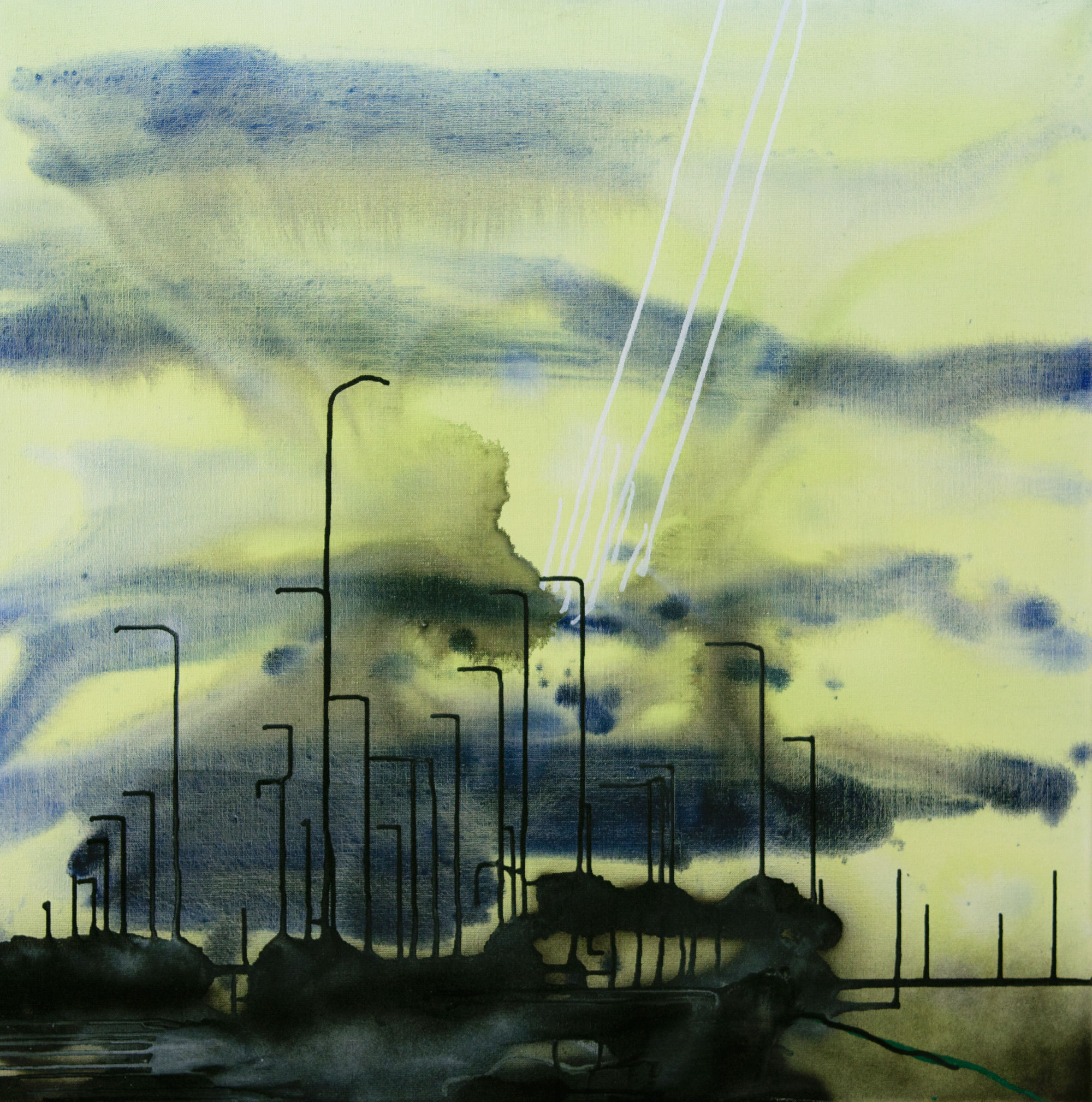
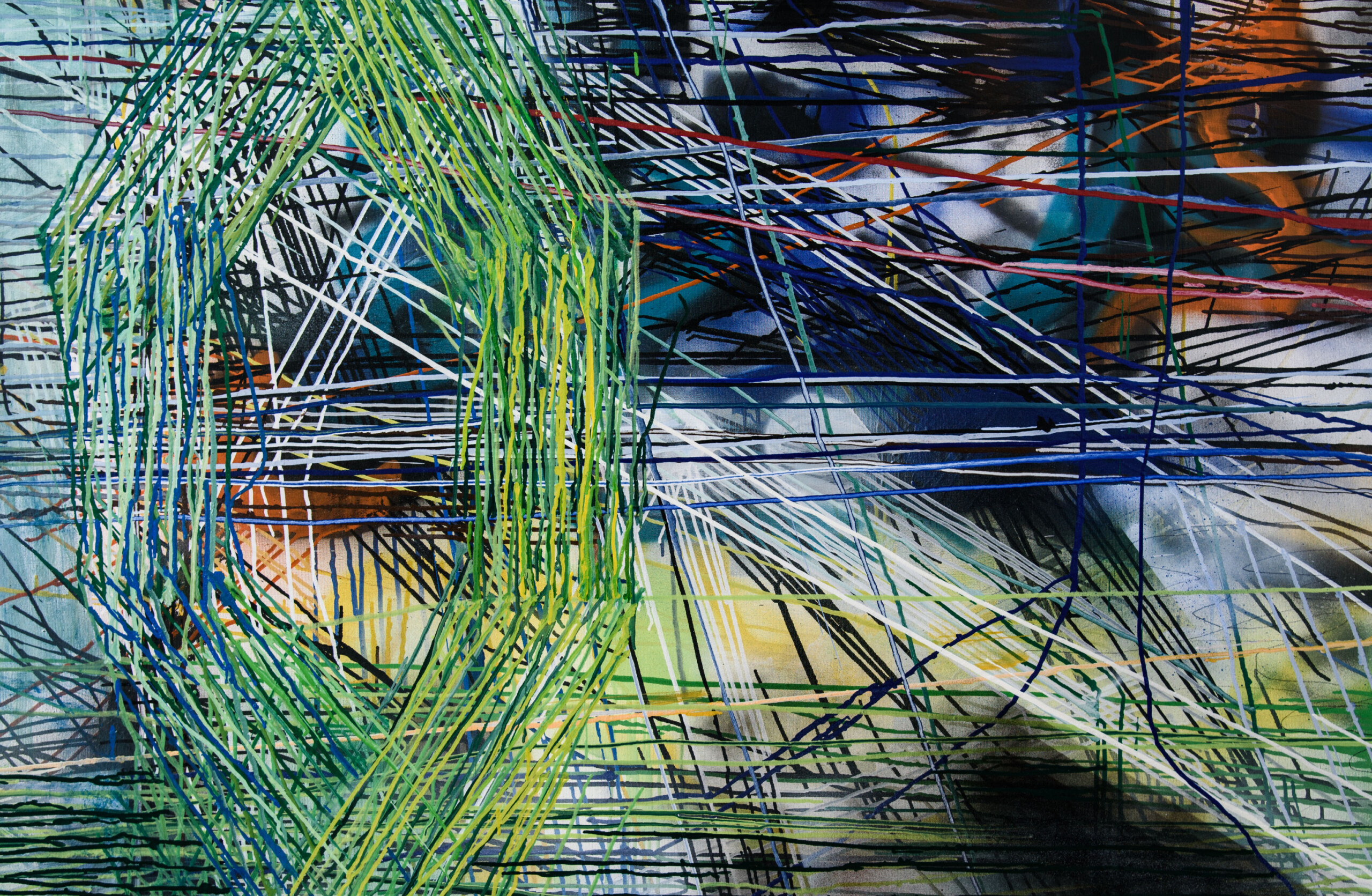
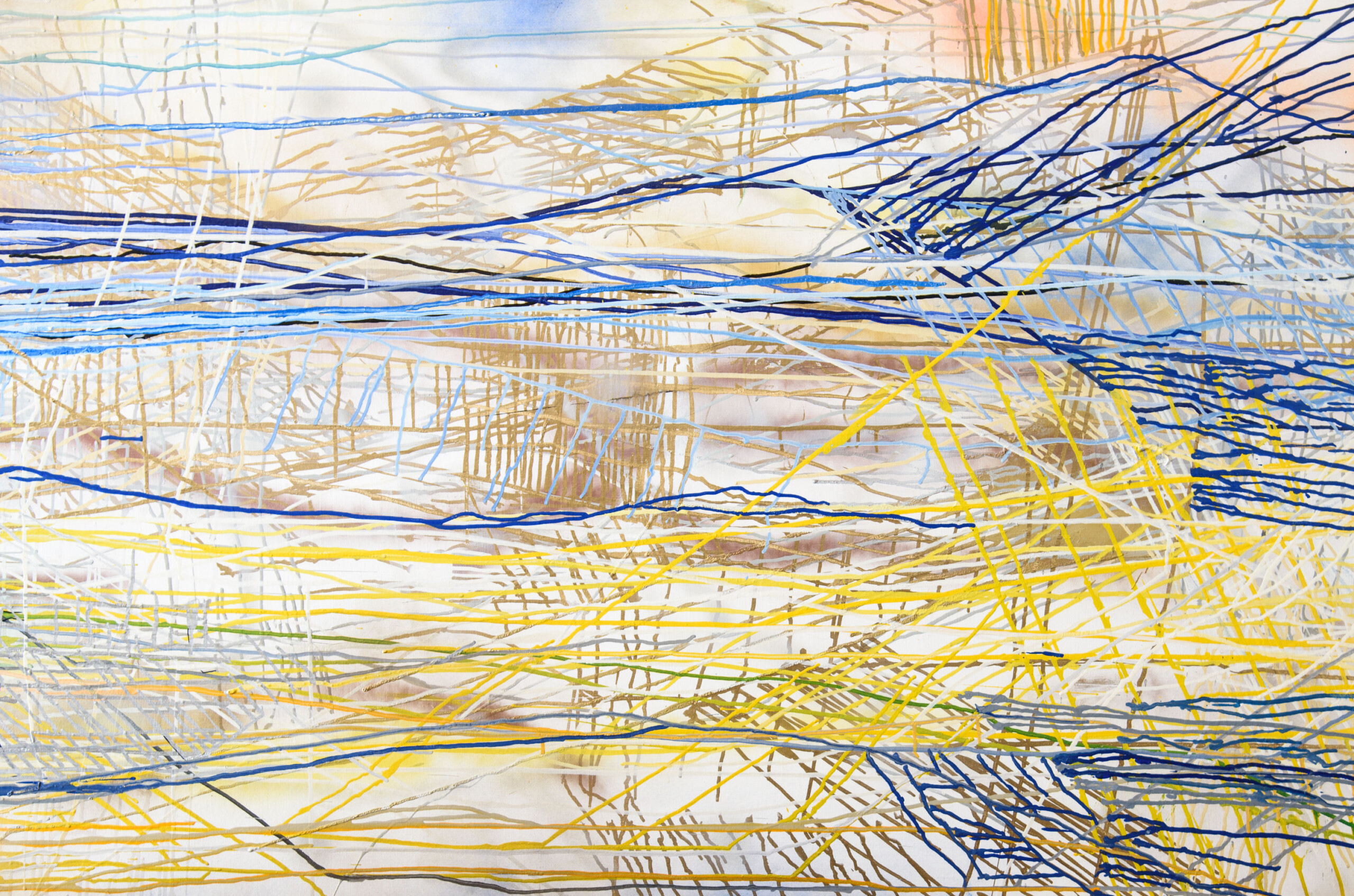
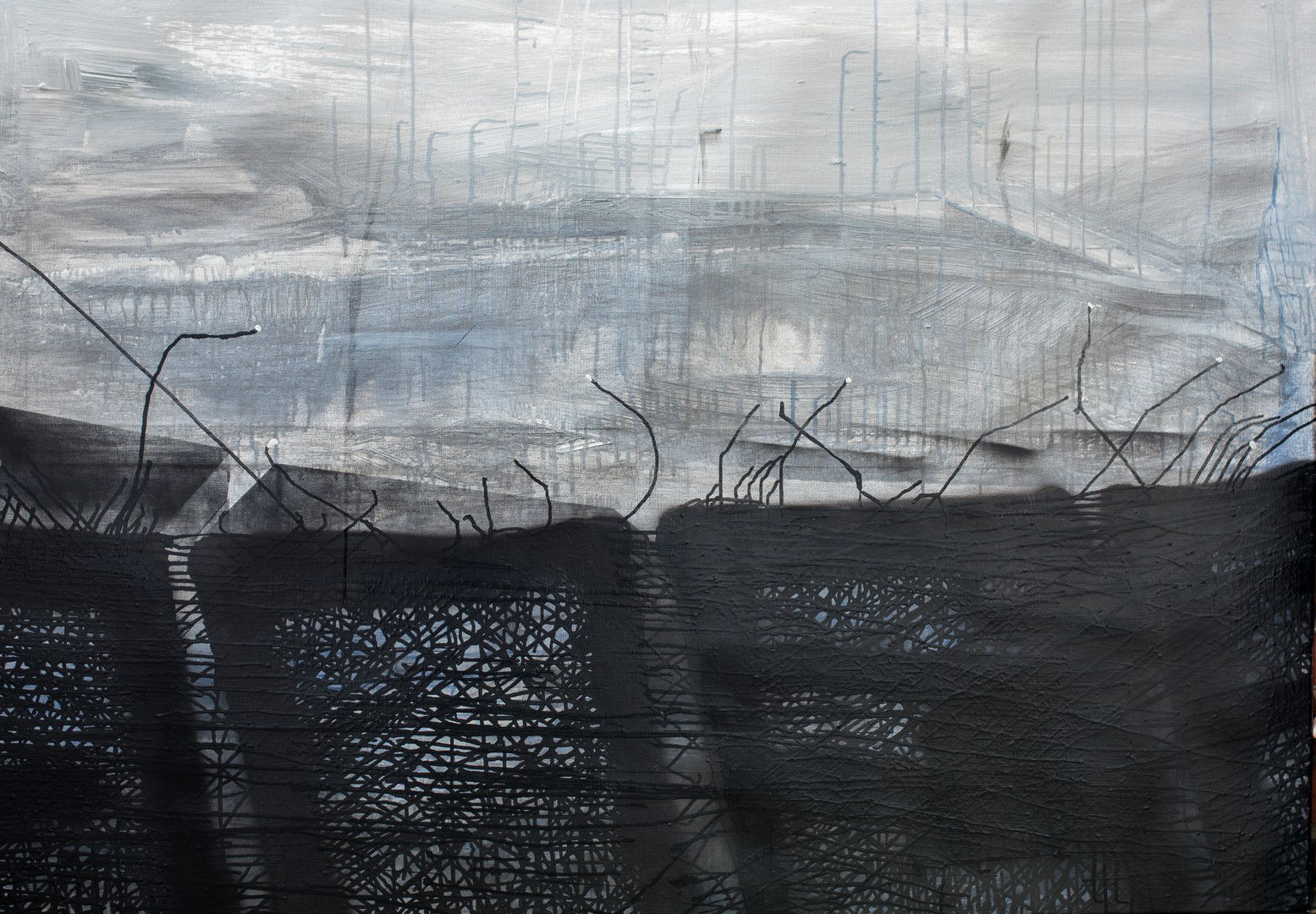
Although Grzegorz Pleszyński is an artist active in many fields – from the visual arts to performance art to music – the exhibition at the Municipal Gallery bwa in Bydgoszcz focuses mainly on his paintings. The exhibition comprises works from various series created over the past dozen or so years: Oddycham powietrzem, które namalowałem (I breathe the air that I have painted), Słyszę tylko drżenie skóry (All I can hear is the trembling of skin), Gdzie się podziali ci wszyscy ludzie ( or Kwanty energii (Quanta of energy). What unites them, above all, is that they spring directly from the artist’s sense of being immersed in the world, as well as from experiences of specific spaces and places – both those close at hand and those geographically distant, explored during numerous journeys.
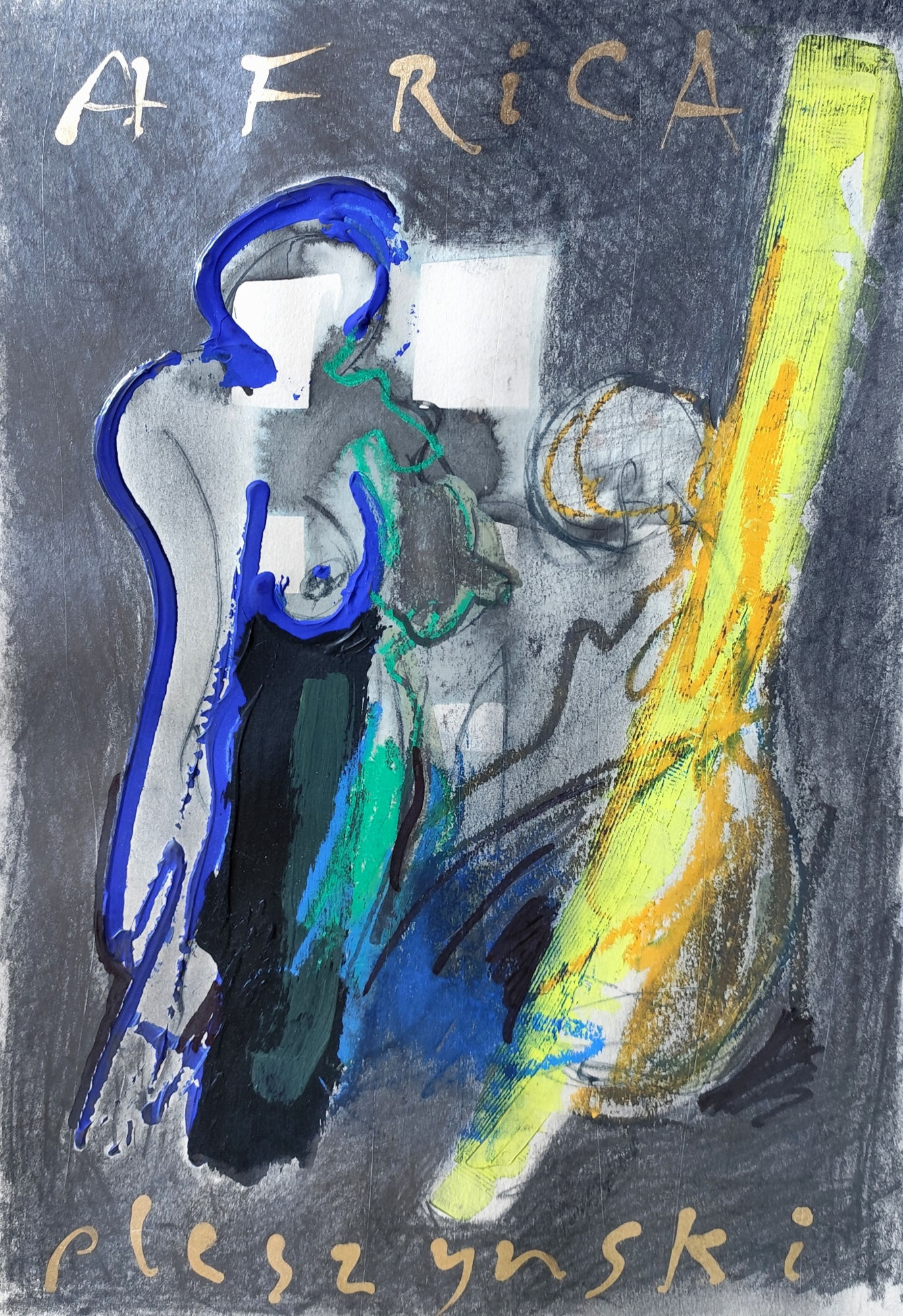
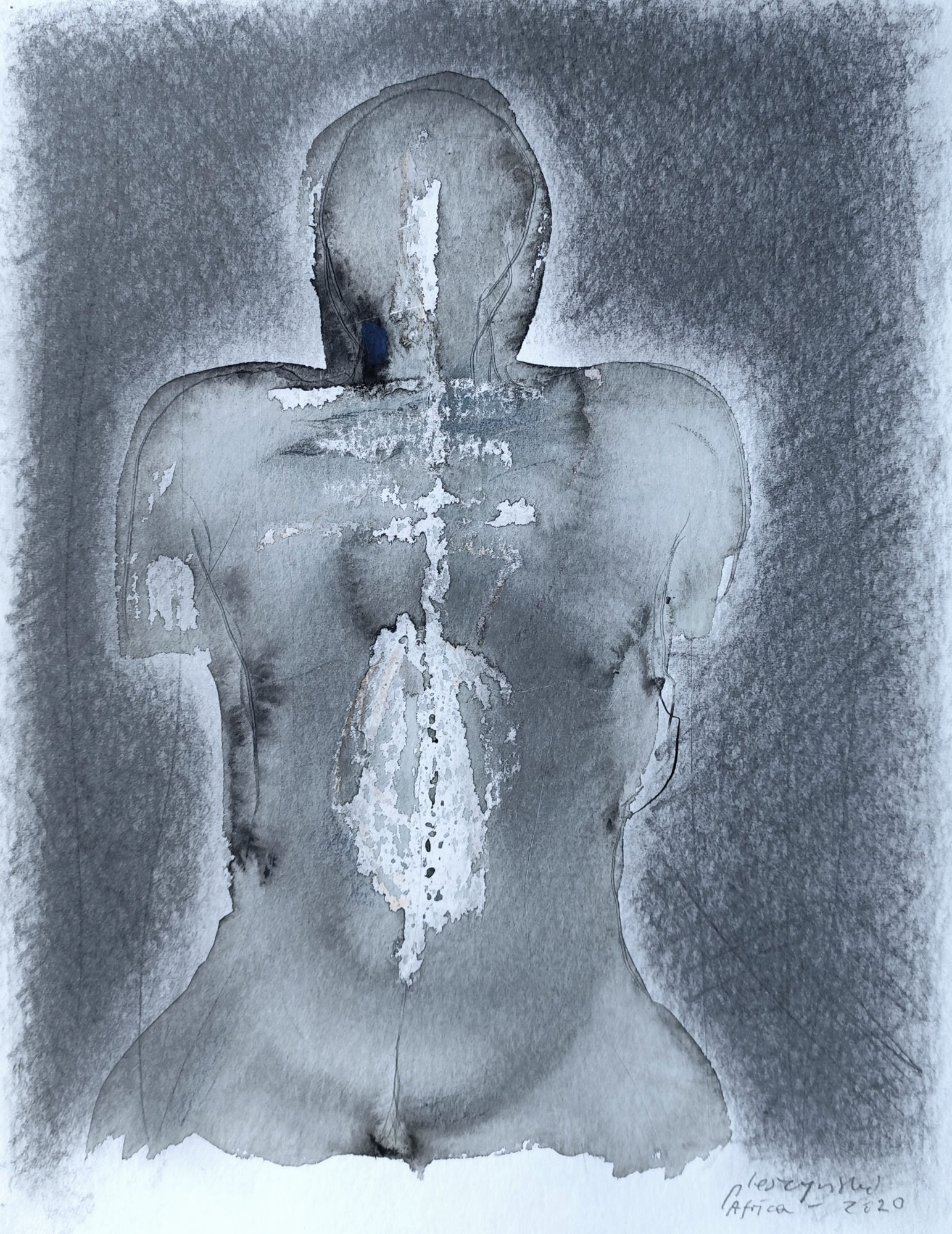
Pleszyński is a nomadic artist who explores new places and cultures with curiosity and an open mind. He has travelled to Western and Eastern Europe, Israel and Australia, but it was undoubtedly his visit to Luanda – which he made before the pandemic, in 2019 – that had a profound impact on him. The image of a primeval Africa, unspoilt by civilisation, which he had brought with him, faded when confronted with the metropolitan backdrop of Angola’s capital. Monumental buildings, slums, congested roads teeming with speeding cars, a degraded natural environment. Pleszyński’s imaginings about the unspoilt and unfathomable nature of the Dark Continent were crushed under the weight of reality. The artist found the only traces of his own imagination in the art created there. “The stretched canvases of the paintings tremble with the spirit of a vanishing, untamed Africa” – he recalled on his return. And almost immediately did he resolve to translate his own observations, reflections and fantasies into paintings.
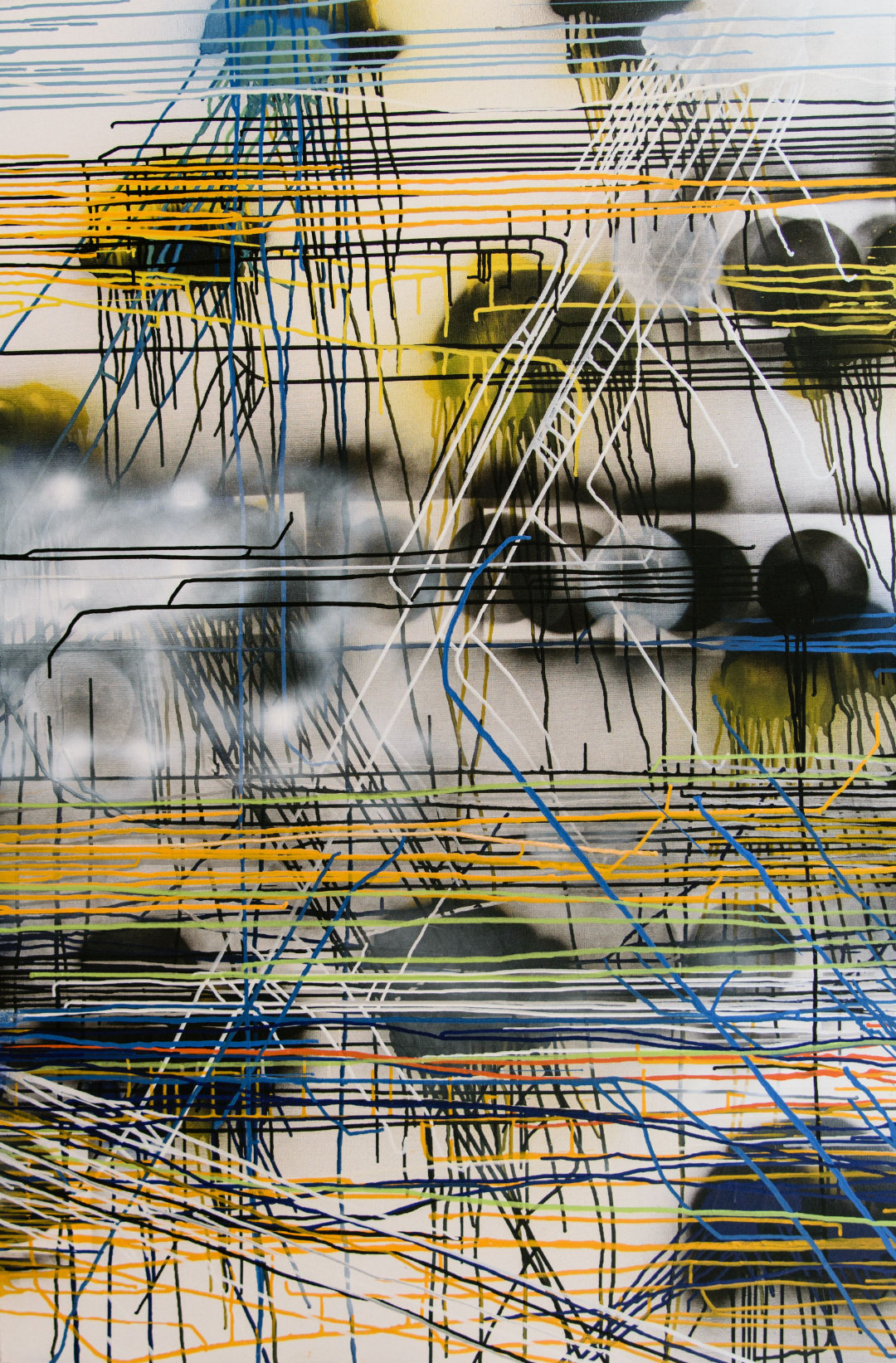
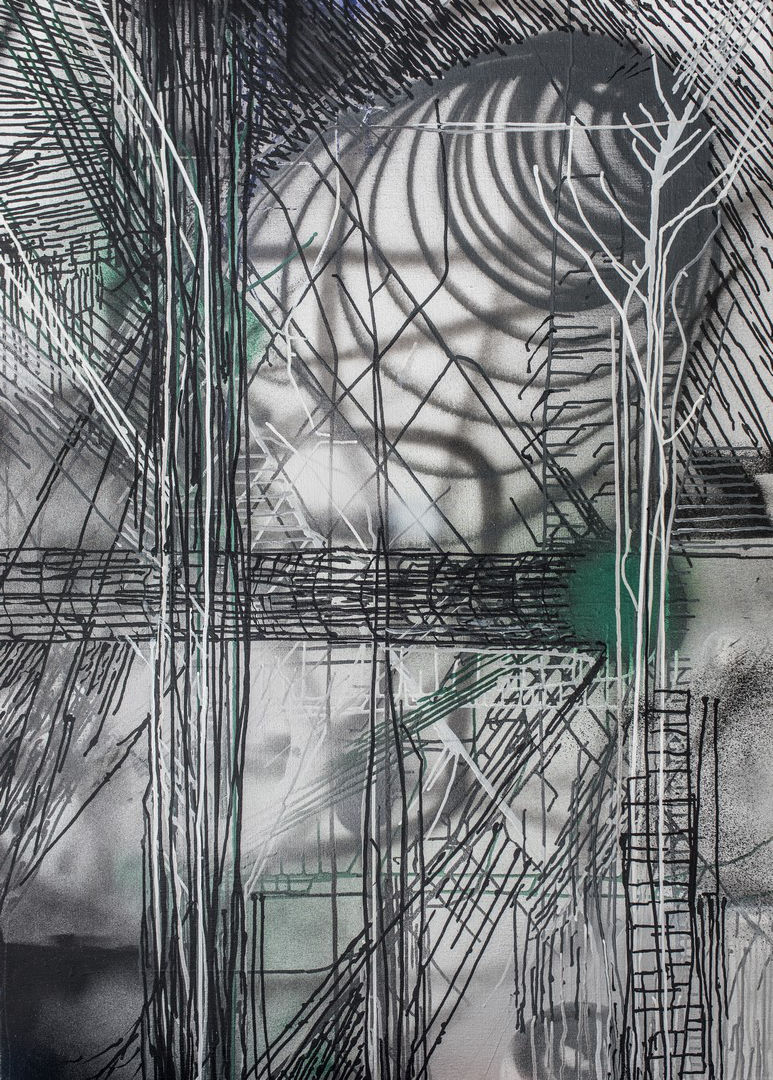
In these works, we will not find specific people, landscapes or situations – rather, after-images of undefined phenomena, fragments of forms, particles of a place’s energy. However, our natural, physiological tendency to associate perceived forms with real shapes leads our eyes to see, in these canvases, urbanised areas, industrial districts, post-industrial ruins, seafronts, barbed-wire fences and roads lit by rows of street lamps. Open to various associations and not imposing a single interpretation, the paintings evoke that ‘African tremor’ thanks to the ‘strings of colour’ with which they are covered. In creating them, Pleszyński employed his characteristic technique of working with streaks of paint flowing down according to the principle of controlled chance. The linear arrangements thus created vibrate, resonate and sound in time with, and at the behest of, the artist’s impressions and memories.
Pleszyński’s ‘African’ paintings, in their condensed form, reflect values that are also present in other series, such as Happy Animals and New Graffiti. These works do not seek to be slaves to illusion – they remain material objects, constituting a record of the process of their creation, which has a strictly physical and corporeal dimension. Maurice Merleau-Ponty placed particular emphasis on this (often overlooked) aspect of creative work; quoting Valéry, he said that a painter, on going to his studio, ‘takes his body with him’ (Maurice Merleau-Ponty, Oko i umysł. Szkice o malarstwie (The Eye and the Mind. The Eye and the Mind), Gdańsk 1996, p. 20). Similarly, Pleszyński interacts directly with the canvas, applying paint to it and manoeuvring the stretcher in various directions so that the paint flows in a specific way. However, his works remain rooted in the body on another level as well. His paintings – particularly those inspired by his travels – draw their inspiration from the artist’s multisensory memories, which he gathered at a specific time and in a specific place.
We remember the places we have been to for various reasons. However, an indispensable element of the process of recording a memory remains the fact that this space had an effect on our bodies, which are at the heart of human experience of the world. “(…) the street assaults the eyes, ears and nose” – wrote Maria Poprzęcka, recounting her impressions of her trip to India (Maria Poprzęcka, Turysta (Tourist), [in:] Na oko (At a Glance), Gdańsk-Warsaw 2015, pp. 9–10). Pleszyński’s flashbacks to Luanda are similarly described through the senses. Fading scents, the trembling of the skin that can be heard, the murmuring waves of the grey Atlantic – these few descriptions alone, used by the artist to describe the works created under the influence of his trip to Africa, bring home just how many associations his body has conjured up around the places he has remembered. They have generated existential experiences that take on sensory forms, which, in a broader perspective, also influence the experience of subjectivity: they prompt self-reflection and raise questions about one’s own identity in the face of a changing environment. “Nowhere, I suppose, is the provisional and precarious nature of one’s ‘self’ felt as acutely as when travelling,” Poprzęcka observed in her essay on the tourist. She added: „(…) this sense of instability is all the stronger the more the visible world appears alien, incomprehensible and distant from our everyday lives, which give our ‘self’ a false sense of identity and stability” (Maria Poprzęcka, Tourist, [in:] At a Glance, Gdańsk-Warsaw 2015, p. 13).
That sense of inner turmoil accompanied Pleszyński not only on his journey, but also remained with him long after his return to Poland. The dissonance between his memories and his original notions of African reality, as well as the sense that his understanding of it was merely superficial, led to a desire to immerse himself in it anew through art. In the microcosm formed within the artist’s mind – or (as Pallasmaa put it) a ‘metropolis’ shaped by memory and imagination – Pleszyński does not so much paint the air he breathed as breathe the air he has painted…
Natalia Cieślak
Grzegorz Pleszyński – artist and teacher, a graduate of the Faculty of Fine Arts at Nicolaus Copernicus University in Toruń. He is a recipient of a scholarship from the Minister of Culture and National Heritage (2013, 2020) and has received scholarships from the Mayor of Bydgoszcz on several occasions.
He has exhibited his work at numerous exhibitions in Poland and abroad, including in Israel (Tel Aviv-Jaffa), Angola (Luanda), Australia (Sydney, Melbourne), Russia (Samara), Germany (Nuremberg, Berlin, Duisburg, Düsseldorf, Kassel), as well as in Italy, Belgium and Denmark.
One of the artist’s most significant initiatives in the field of promoting culture and the arts is the ‘Antidepressant School – Week of Colours’ – an original project that has been running continuously for 25 years. Several hundred schools and educational institutions from Poland and abroad took part in it.